
A new Benjamin Button in London is challenging ageist cliches
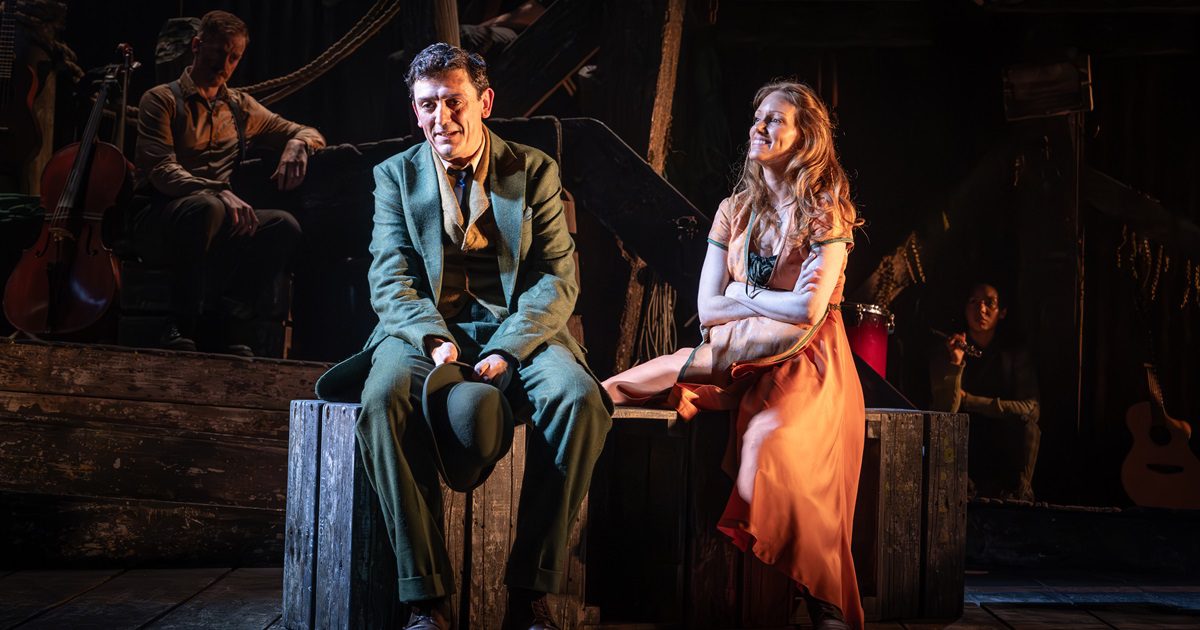 John Dagleish (Benjamin Button) and Clare Foster (Elowen Keene). Photo Marc Brenner
A story that already focused on ageing and ageism has a new makeover and message
London’s cosy Ambassadors Theatre is home to a new take on The Curious Case of Benjamin Button. If you loved the 2008 Hollywood production with Brad Pitt and Cate Blanchett’s impeccable cheekbones, take note. This is an intelligent take, with a new British angle.
Jethro Compton has reworked the story by moving it to a Cornish fishing village, with much of the action taking place in the Pickled Crab pub.
Benjamin Button, played brilliantly by John Dagleish, is born a rather cantankerous old man to humble parents. And without giving too much away, he starts to age backwards, while everyone around him gets older. The passing of time cracks along nicely with the ridiculously talented cast singing, acting and playing their own instruments.
There’s no sunken orchestra pit of anonymous musicians here
Instead, everything from guitars, to a double bass, to a French horn is played live by the characters. Incredibly, a cast of 13 play thirteen different instruments.
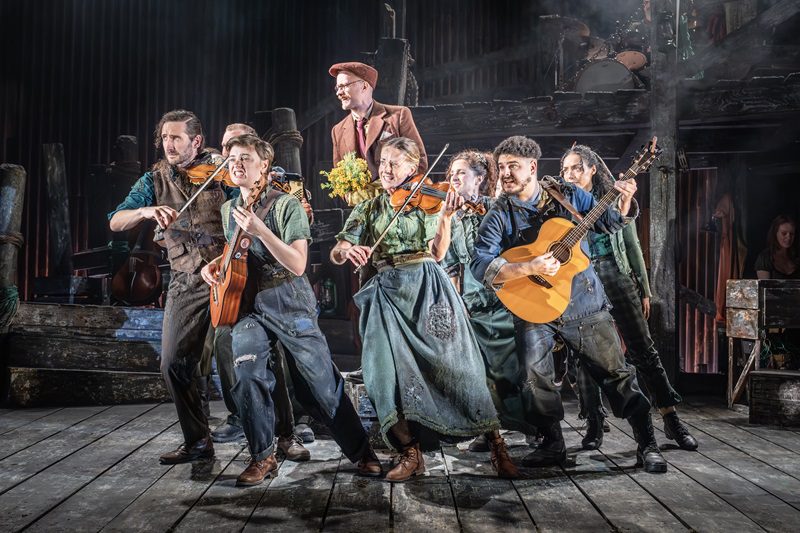
Photo Marc Brenner
Of course, it’s easy to take home obvious messages from this tale, loosely based on F. Scott Fitzgerald’s 1922 short story. Sure, it’s important to carpe the hell out of the diem. To tell someone you love them. Or that you’re sorry, or that they’re forgiven, before it’s too late. But that’s a message you can get from pretty much any given rom-com.
The message that resonated with me long after the Saturday matinee was that it’s high time we got over a few of the cliches about ageing that we often utter without really thinking about them.
Sure, it’s important to carpe the hell out of the diem… but that’s a message you can get from pretty much any given rom-com.
Anyone who has ever regretted something from their youth has likely uttered, “If I knew then what I know now…”. But when you see Benjamin Button getting to be the young man who already knows the lessons of later life, it’s an uncomfortable experience.
He may indeed have the wisdom of age in an increasingly younger man’s body. But it turns out that you still can’t change the people and events around you. The pain of this is etched on Dagleish’s face as he knows he will regress to babyhood and forgets everything he ever knew, while everyone else’s life moves ahead in the usual direction.
Read more: What it’s like doing amateur dramatics
Youth is not ‘wasted on the young’
Of course, only a rare – and probably deeply annoying – human being would look back on their life and honestly say they would have done everything exactly the same if they knew then what they know now. But equally, life is a process, a bell-shaped curve where we start out knowing nothing, we grow, we learn, we develop, we reach peaks and, if we’re lucky, we fade away at a ripe, old age.
This brings me to another tiresome cliche: “Youth is wasted on the young.” No. It absolutely is not. What better time to be silly, to make mistakes, to try new things than when you are unencumbered by cynicism or fear or second-guessing yourself? Of course, this means there is an attrition rate among the young.
There will always be a latter day Icarus who flies too close to the sun. And there will always be the heartbreaking stories of kids forced to grow up too soon because of circumstances beyond their control, such as poverty and losing parents at an early age. These themes of hard, young lives are apparent in this Benjamin Button performance, with the distinctly non-Hollywood setting of an early 20th century Cornish fishing village where few had an easy life.
But those of us who were fortunate enough to have a misspent youth, to have gotten away with the bad life choices and general idiocy, can rejoice, celebrate and look back fondly on it all. Maybe we can try and pass on the things we’ve learned to those who come after us, but we have to accept that our advice will not always be taken, just as we refused to take good advice in decades past.
In Benjamin Button, we see a man who is being chased by death in reverse
As someone born old, he is bemused by the joyous scenes in the bar of people singing, carousing and being merry. And as he gets younger, he only briefly gets to enjoy being the same age as his one true love – a rich, complex performance by Clare Foster as formidable and tragic Elowen Keen. His kids start to catch up with him in age, creating unexpected family tensions.

John Dalgleish as Benjamin Button. Photo Marc Brenner
The beauty of the performances of this latest incarnation of Benjamin Button, the deft script, the repeated song about the tide coming in, and the musicians as narrators counting away his backwards life by the years, months and days force you to confront your own mortality. Indeed, many of us will end our days in a state where our minds have rusted away, our memories gone forever, as helpless as when we were born.
But this is not to say The Curious Tale of Benjamin Button against the backdrop of a tough fishing village, a world war and family loss, is a morbid affair. Quite the opposite, in fact. By breathing a collective sigh of relief that there is sense, logic and rhythm to ageing the way we do, we can celebrate everything good about every stage of life. As a bonus, with this intimate, heartfelt performance, we can do that with a few rollicking sea shanties that had even the most cynical theatregoers clapping along by the end.

In a career that has spanned Australia, the Middle East and the UK, Georgia has written about all sorts of things, including sex, cars, food, oil and gas, insurance, fashion, travel, workplace safety, health, religious affairs, glass and glazing… When she’s not writing words for fun and profit, she can usually be found with a glass of something French and red in her hand.
Read all about it

Leave a comment