
How to spot an Asian hornet and what to do
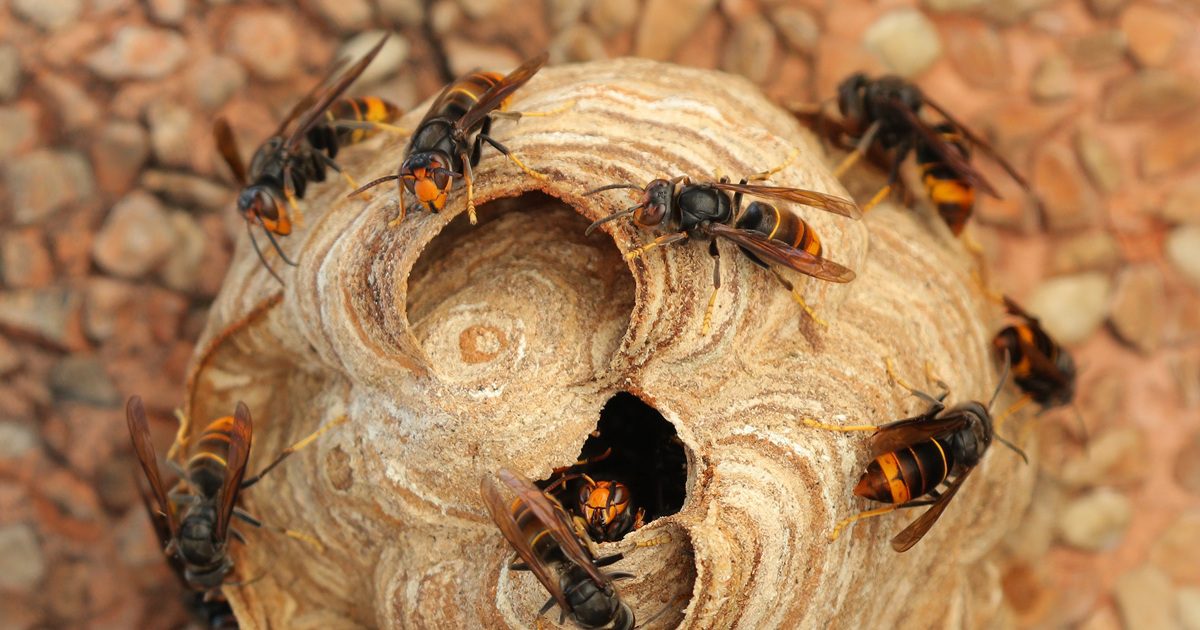
Would you know your Asian from your relatively harmless European hornet?
The Asian hornet (Vespa velutina nigrithorax) first appeared in France in 2004, likely brought in accidentally among imported pottery from China. From there it spread rapidly across the continent, establishing itself in Spain, Italy and beyond.
The UK saw its first confirmed sighting in 2016 in Gloucestershire. Since then, the National Bee Unit has tracked dozens of nests across southern England, with numbers rising steadily in 2023 and 2024. Each year, the hornet’s ability to disperse and establish new nests makes containment more difficult.
Why they pose a threat
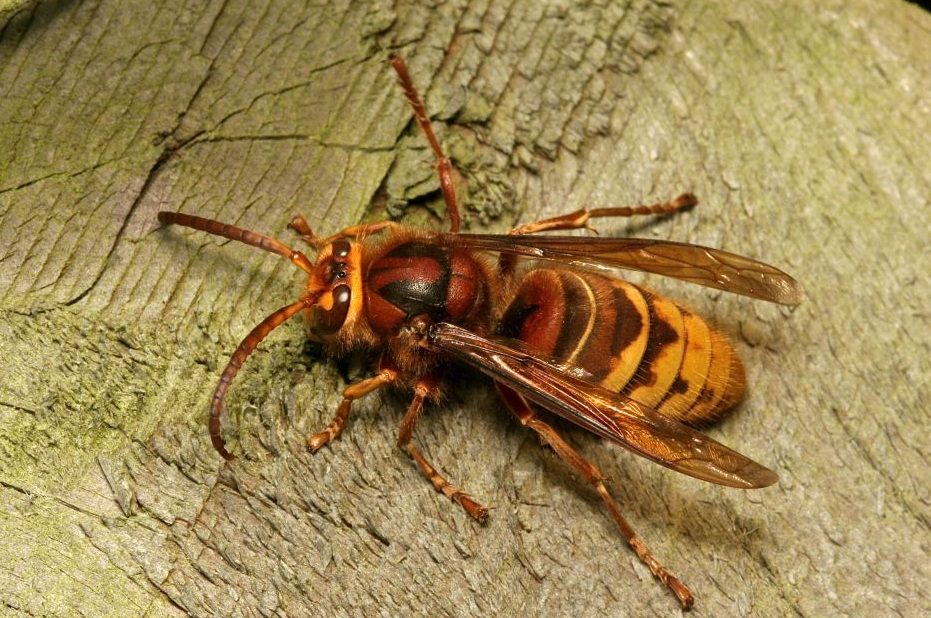
Vespa crabro, European Hornet. Source National Bee Unit / UK
Unlike our native European hornet (Vespa crabro), which generally avoids humans and plays a role in controlling insect populations, the Asian hornet is a serious predator of honeybees and other pollinators. A single nest can contain thousands of hornets, and each adult consumes large quantities of insect prey. Beekeepers in France have reported colonies of honeybees wiped out in days. For agriculture and food security, this matters. Pollinators are already under pressure from habitat loss, pesticides and climate change; adding an invasive predator tips the balance further.
Asian hornets are not especially aggressive towards humans unless their nest is threatened, but their sting can be painful and, in rare cases, dangerous for those allergic to wasp or bee venom. The bigger concern is ecological. A fall in pollinator numbers undermines crops, wild plants, and the wider food chain.
How to tell the difference

Sussex Wildlife Trust (CC BY-NC 4.0)
Identification is crucial. The European hornet is larger, with a yellow head, reddish-brown thorax and legs that are brown at the top and yellow at the bottom. They are noisy in flight and tend to avoid conflict.
The Asian hornet is slightly smaller. It has a velvety dark brown or black body, with a distinctive yellow or orange band near the end of the abdomen. The legs are dark with yellow tips, giving a “dipped in paint” appearance. The face is orange with darker antennae. They build large paper nests, often high in trees, but sometimes in sheds, garages or roof spaces. The nests are spherical with a small opening near the bottom.
If you see a large hornet with mostly dark colouring, yellow-tipped legs, and an orange face, it is likely an Asian hornet.
Why we should care
The UK government estimates pollinators contribute hundreds of millions of pounds to the economy through crop fertilisation each year. Losing bees to an invasive predator would drive up costs, reduce crop yields and threaten food supplies. In France, where Asian hornets are firmly established, beekeepers have suffered severe losses and the costs of nest removal run into millions annually.
For the public, awareness matters because early detection is the only chance to slow their spread. Once a nest produces new queens in autumn, those queens disperse, hibernate through the winter and establish fresh nests the following spring. One overlooked nest can create dozens more the following year.
What to do if you see one
The key advice is: do not attempt to destroy a nest yourself. Asian hornets defend aggressively and can attack in numbers if disturbed. Instead, try to take a photograph from a safe distance, note the location, and report it.
In the UK, if you think you have seen an Asian hornet, please report it using the free Asian Hornet Watch App, available for Android and iPhone, on the online notification form, or by emailing alertnonnative@ceh.ac.uk. A photograph and the location of the sighting must be included. Please include your contact details so they can get in touch. Submissions are verified by experts, and authorised teams are sent to track and destroy nests. Quick reporting has led to successful nest removals in Kent, Hampshire, and elsewhere.
If you are a beekeeper, setting monitoring traps in spring and late summer can help detect queens before they spread. These must be used carefully to avoid killing native insects. Guidance is available from the National Bee Unit and beekeeping associations.
Living with the risk
The Asian hornet is unlikely to be eradicated completely in Europe, but swift action can reduce its impact in the UK. Public awareness, accurate identification, and rapid reporting are essential tools. Knowing the difference between the harmless European hornet and its invasive cousin is the first step.
The spread of the Asian hornet reminds us that biosecurity matters. A single shipping container two decades ago set off a chain of events still unfolding across the continent. In the face of climate change and global trade, invasives like the Asian hornet will continue to challenge our ecosystems. For now, vigilance is our best defence.

If you’d like to receive a regular mini-magazine direct to your inbox with a selection of editorial features to read at your leisure, please sign up for our newsletter. We also run the odd competition and offer and whatnot, and newsletter members get the heads-up first.
Read all about it

Leave a comment