
A Sicily holiday in winter: ancient wonders and everyday joy
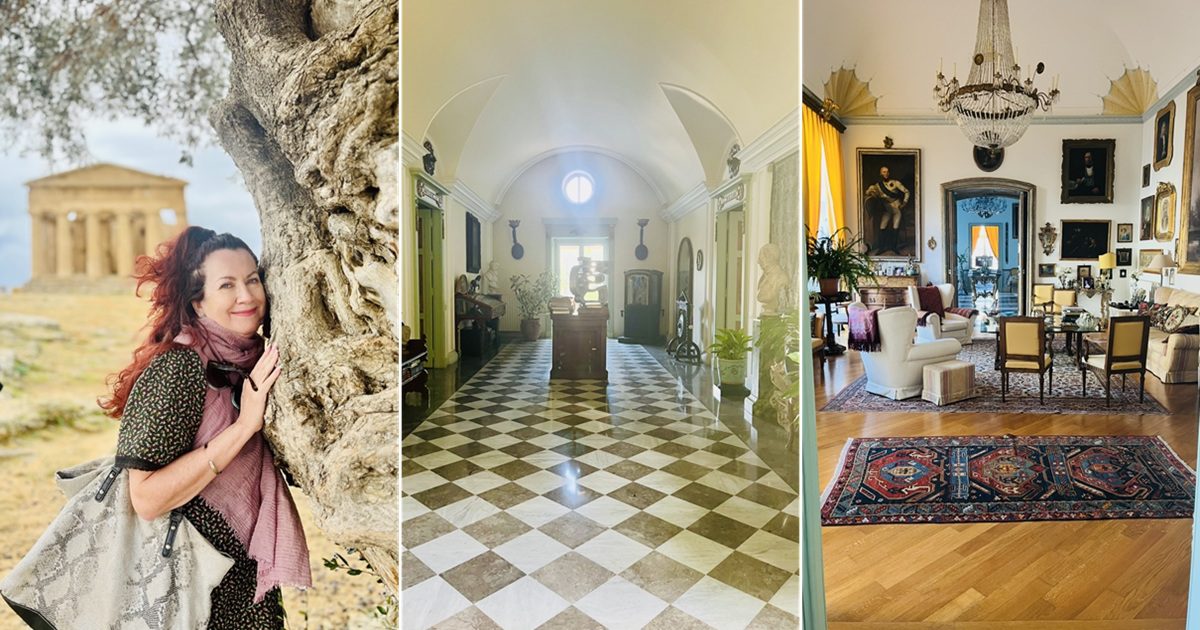
Winter sun, ancient ruins and very good food. Jacqui Deevoy spends five days in Sicily exploring Greek temples, making pizza in the Valley of Temples, and easing into island life at a luxurious eco spa…
It’s early December and I’m realising that, although the sun is shining, perhaps it wasn’t the best idea to wear a short-sleeved summer dress on this particular expedition. One of the group lends me a thin scarf which keeps the chill off my chest and neck, but the slightly biting wind still whips about my goosebumped bare arms.
The guide and locals are in winter mode ready for our trek – puffa jackets, snoods and woolly hats – so I’m sticking out like a sore thumb. But I just tell myself the 12-degree breeze is positively bracing, and that a bit of air to the bottom never did anyone any harm before proceeding to hike up the steep slope to the Acropolis.
Yes you read that right – the Acropolis in Sicily…
Founded as a Greek colony in 580 BC, ancient Akragas (now Agrigento) rose to become one of the Mediterranean’s wealthiest city-states. Its Doric temples – seven in total, built between 510 BC and 430 BC – symbolise its golden age under tyrants like Theron, who commemorated victories like the 480 BC Battle of Himera against the Carthaginians.
Designated a UNESCO World Heritage Site in 1997, the 1,300-hectare park remains Europe’s largest archaeological site, where tales of Carthaginian sieges in 406 BC left scorch marks on temple walls, still visible today.
We visit four ancient monuments, each more inspiring than the last
First comes the Temple of Heracles, the oldest on the site, built in the late 6th century BC and now reduced to eight columns after an earthquake. Then there is the vast Temple of Olympian Zeus, begun in 480 BC, once more than 110 metres long and famed for its colossal telamons standing up to 7.5 metres tall.
The tour then takes in the instantly recognisable Temple of Castor and Pollux, marked by four columns reconstructed in the 19th century, before ending at the Temple of Concordia. Built in the 5th century BC and later converted into a church in the 6th century AD, it is the best preserved of them all, its survival owed to that later life.
We also got to admire the metal sculpture of a fallen Icarus, a new addition to the site by artist Igor Mitoraj. The Polish sculptor’s monumental 2011 bronze installation hugs a 1000-year-old olive tree, its gnarled trunk a living relic from the site’s medieval olive groves, symbolising Sicily’s enduring agricultural heritage since Phoenician times.
Our guide Luigi tells us there’ll be an exam at the end of the tour but, fortunately, he’s just messing with us. What actually waits at the culmination of the trek is something far more pleasant.
Time to roll up our sleeves…
Deep within an oasis of cacti and palm trees was a beautiful cooking school and restaurant. In the kitchen area, we’re introduced to the chef and watch reverentially as she tosses dough in flour, pats the resulting pizza bases into shape, and deftly arranges a few toppings. Olives, tomato passata, spinach and cheese, before she tosses the pizzas into the fiery oven. Then it’s our turn.
One of the group gets a bit over-enthusiastic and piles his toppings way too high, causing a near-disaster in the oven. The pizza catches fire and, as the chef tries to rescue it, it collapses and has to be tossed into the embers! Despite me not being the greatest of cooks, I’m relieved my creation emerges in one piece. Within a minute or so, the sizzling results are shovelled out onto wooden boards, ready for consumption.
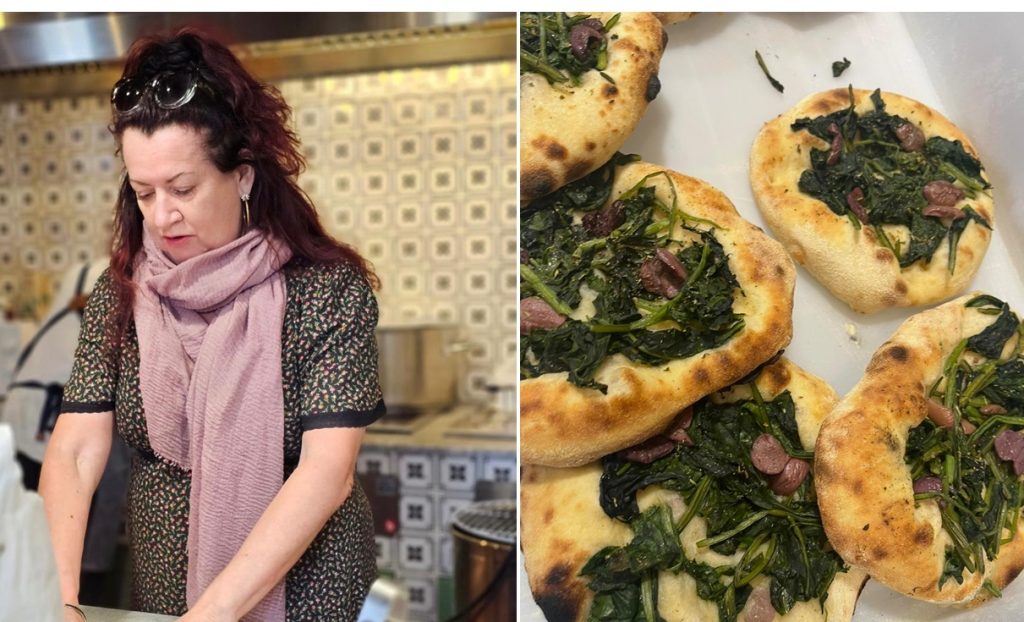
My pizza, even though I say so myself, is not only easy on the eye (I got a bit arty) but is also absolutely delicious with all the same toppings but arranged differently. After wolfing down our creations in the restaurant, we’re presented with a vegetarian smorgasbord of delight: pasta with lentils, roasted potato wedges and cubed pumpkin, followed by a dessert of almond tart and Sicilian orange mousse. And lashings of local vino of course.
Too stuffed to walk back, we thankfully get a lift from the lovely Adler hotel/spa driver Adriano, who tells us that in a past life he was a session musician touring with the likes of Emeli Sandé. That’s a whole another story.
In a single five-day winter’s trip to Sicily, I saw so much
I was privileged to stay in the capital Palermo at a beautiful private residence/palazzo – the Palazzo Pantelleria, run by the charming and accommodating Francesco Cazzaniga, nephew of the owner. And I also got to attend a talk by author Francesca Campioli on her book – A Parigi Con Stile – about fashion designer Coco Chanel.
I visited the local marina and ate the most delicious ice-cream I’ve ever tasted; I had salted caramel and dark chocolate and Francesco had mango and prickly pear. Our choices were chalk and cheese. That was after the breakfast of local croissants, fresh fruit and coffee that Francesco had kindly prepared for me. Needless to say, eyes bigger than belly, I couldn’t finish the ice-cream.
Back at the palazzo, l had a wander around the property
 Housed in the 14th-century fortified outpost, built in the late 1300s and later owned by the Spanish Requesens family under Charles V, the palazzo was rescued from ruin in 2002 by Francesco’s collector uncle Massimo Cazzaniga. Cazzaniga transformed it over two decades into an 11,000-square-foot home museum of Baroque frescoes, Venetian tiles and eclectic antiques from global ports.
In the backstreets behind the Palazzo Pantelleria, on our walk to the marina, Francesco told me about the days of the Spanish Inquisition, when prisoners were executed outside the nearby Palazzo Chiaramonte Steri – the 14th-century Gothic stronghold turned Inquisition tribunal from 1604 to 1782. Legend says the local executioner had to scurry, hooded and incognito, through the narrow alleyways, hoping he wasn’t spotted or recognised by locals who disapproved of his actions and choice of career.
Under Spanish Habsburg rule from 1479, the Holy Office targeted Jews, Muslims and “heretics” in Sicily’s diverse melting pot, leading to mass expulsions in 1492 and brutal interrogations in Steri’s graffiti-scarred cells, where desperate prisoners etched poems in Sicilian, Latin and Arabic-Judaic, invoking Dante’s Inferno amid tortures like the rack and waterboarding.
I didn’t think a night at the Palazzo Pantelleria could be surpassed
But then the taxi arrived ferried me to the heavenly Adler Spa Resort Sicilia two hours away from the capital. I say ‘heavenly’ because this stunningly-designed eco-spa is perfect in every way. When I wasn’t pinching myself awake from the blissful dream I thought I was having, I did actually feel like I’d died and gone to heaven.
On a hillside overlooking the Agrigento coast in Siculiana, sitting alongside the Torre Salsa Nature Reserve, this eco-luxe retreat, built with humidity-regulating Sicilian clay walls and volcanic rock cladding, offers thalasso pools, Pilates sessions and farm-to-table Sicilian fare in a serene Mediterranean paradise.
The highlights of my five-day trip most definitely included the pizza-making in the Valley of Temples, but then there was the wine-tasting at the Donnafugata winery – where the Rallo family’s 170-year legacy, revived in 1983 by Giacomo and Gabriella, yields acclaimed vintages like the passito Ben Ryé from UNESCO – protected Pantelleria vines; the swimming in the heated infinity pool at the Adler Spa resort; the one-night stay at the Bella Palermo and that overall feeling of living in the most beautiful dream. I can’t imagine I’ll ever again feel such pleasure in such a short period of time.
December travel info:
Jacqui travelled with Ryanair from Stansted to Palermo airport, return flight £130. She stayed at Travelodge Stansted prior to the flight.
She enjoyed her one-night stopover in Palermo at the Palazzo Pantelleria residence. Contact Francesco Cazzaniga at info@labellapalermo.com for more details and check out the website
The wine-tasting and Valley of Temples excursions were arranged via the Adler Spa Resort Sicilia.
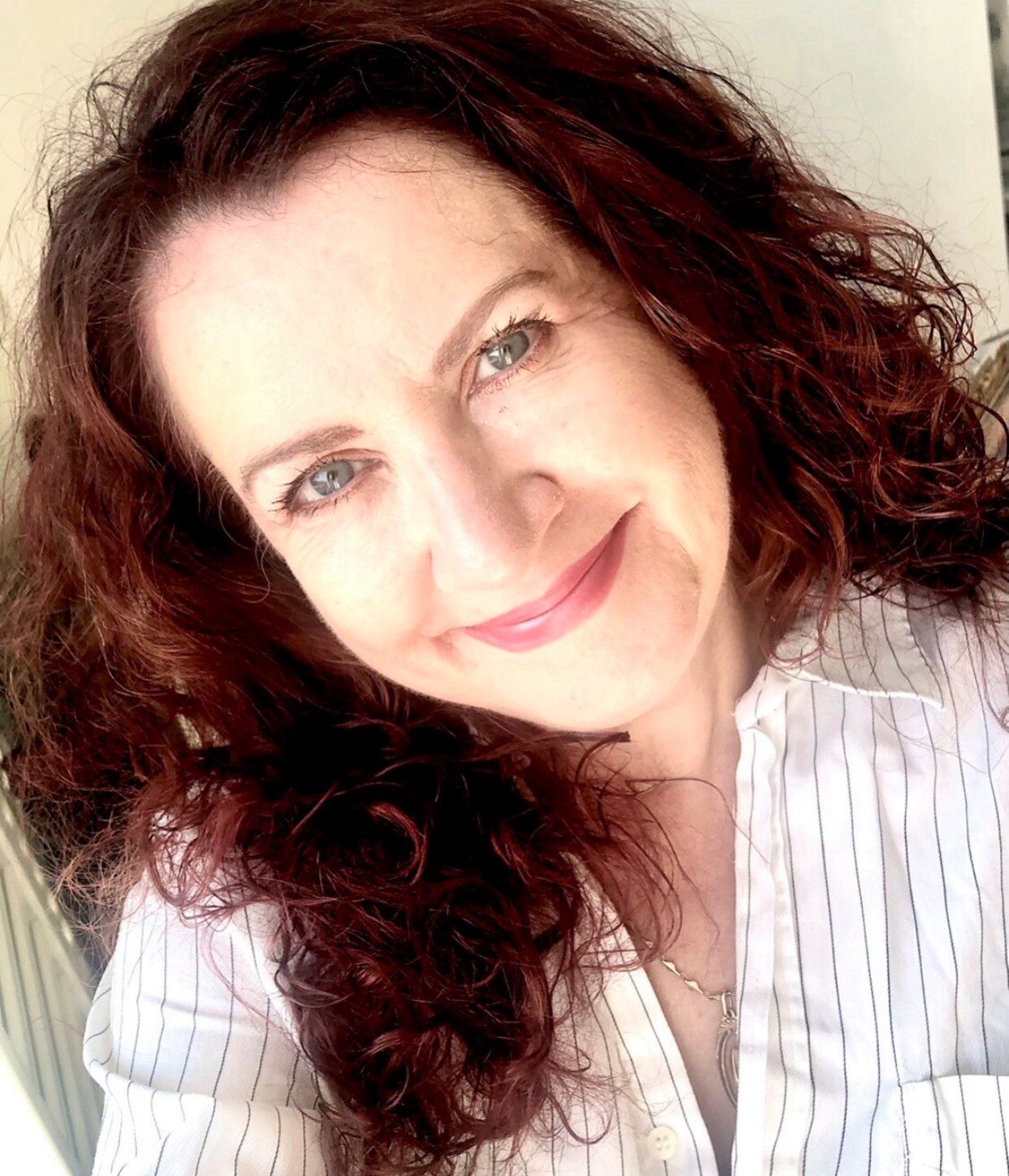
Jacqui Deevoy has been a freelance journalist for over three decades, starting out on teenage magazines, then later working for women’s magazines worldwide, and national newspapers including the Daily Mail, the Mirror, Express and Telegraph. These days, as well as writing for magazines, papers and websites, she produces documentaries and hosts a Monday night talk show for Unprecedented TV.
Read all about it

Leave a comment