
Data protection: still a must for your business

If you think GDPR has gone away, think again. Here’s some advice…
As data protection laws continue to evolve across the world, so too does the public’s awareness of privacy rights. When the GDPR was implemented back in 2018, it ushered in a new era of understanding; one that still shapes consumer expectations to this day. Strong policies and practices for data protection have become a necessary component for building customer trust and loyalty, and it’s no longer just a regulatory requirement, but a fundamental pillar of customer relationships.
In this article, a team of outsourced data protection officers explore how data protection strengthens the foundations of customer trust and loyalty, focusing on transparent communication and Privacy by Design practices – core elements that not only support compliance with data protection regulations, but also enhance an organisation’s customer experience strategy.
Transparency creates trust
The 2024 Data Privacy Benchmark Study revealed that 94% of organisations believe their customers would stop purchasing from them if they did not properly protect data.
This clearly highlights the importance of proper care when it comes to customer data, and in the context of data protection regulations such as the General Data Protection Regulation (GDPR), transparency is a fundamental element of compliance. Under the principle of Lawfulness, Fairness and Transparency, organisations are required to provide individuals with information about how their data is collected, processed, stored, and shared.
This principle is echoed in many other jurisdictional data protection legislations around the world, like Canada’s Personal Information Protection and Electronic Documents Act (PIPEDA) and the California Consumer Privacy Act (CCPA) in the US.
But beyond the requirements for compliance, being open about how your business collects, uses, and protects personal data builds a relationship of trust with consumers. When people know they can rely on your organisation to handle their data responsibly, they are more likely to feel comfortable engaging with your business, and remain loyal to your services.
So how do you ensure transparency?
Exercising transparency should be more than just providing information on your organisation’s personal data processing practices, and should be done in an easy-to-understand and accessible way, so that your customers know what’s happening with their information at all times.
There are some practical and sector-specific examples of how you can approach this, as outlined below.
Use clear, simple language
Communicating in straightforward terms helps your customers (and potential customers) to understand your data practices, without any confusion.
While there may be some complex data processes in play for certain functionalities or services, explaining this in a clear, accessible way will help customers understand how their data is being managed. Stating something to the effect of “we use your browsing history to suggest apps you might like”, removes any jargon that, while technically accurate, may be difficult to understand.
Establish a clear structure and navigation
Organising information in a logical way allows people to find what they need quickly and easily.
For instance, a Healthcare provider could organise their privacy policy into clearly defined sections, such as ‘Patient Data’, ‘Appointment Information’, and ‘Billing Details’. This makes critical information easily accessible and allows patients to navigate the policy with ease.
Incorporate visual aids
Visuals such as infographics, flowcharts, or graphic elements are a great way to simplify complex information. In many cases, clear imagery can be processed easier than sections of text; instead of a long list of all the different types of personal information you collect, you could use icons instead. For an insurance company, this could mean using an icon of a house for property details or a car for vehicle information. This visual representation enhances understanding and makes the data collection more transparent.
Ensure proper placement
Making important information easy to find is a vital element of proper transparency.
When it comes to eCommerce sites, this could mean displaying a prominent link to privacy policies during the checkout process, ensuring customers can easily review it before making a purchase. FAQ sections and visual aids can also help in simplifying the information for better understanding. Enabling customers to review key information before making a purchase could lead to an avoidance of complaints further down the road.
Privacy by Design
Earlier, we referenced the 2024 Data Privacy Benchmark Study. Another statistic drawn from this study shows that 80% of organisations reported significant improvements in customer loyalty and trust as a result of investments in privacy measures. This increased to 92% among organisations that considered their privacy programmes as being ahead of their competitors.
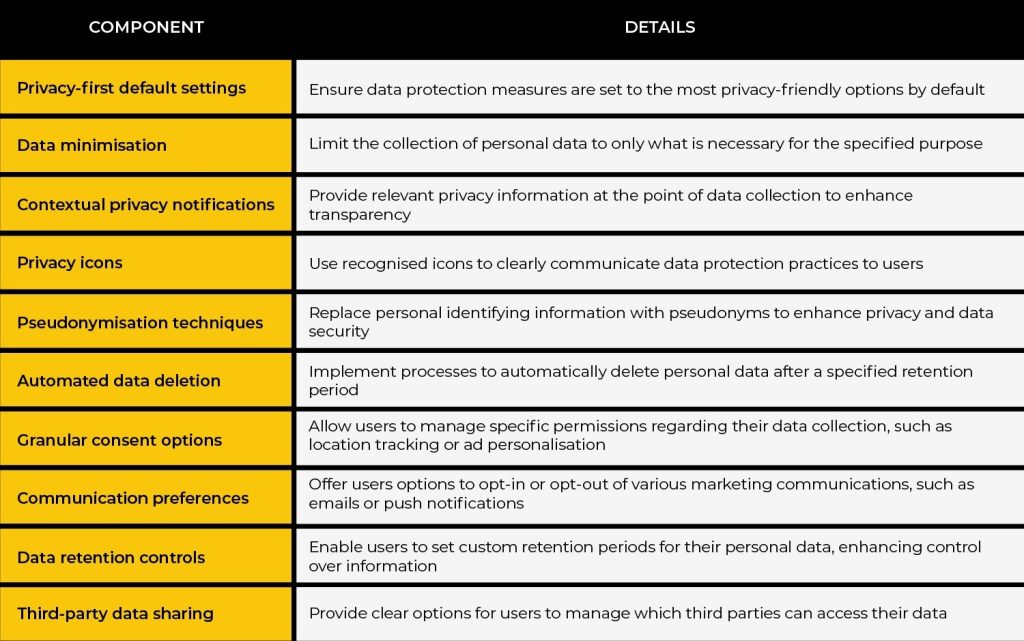
Evidently, embedding privacy measures into the core of business operations is a vital component of success. Proactive strategies, like Privacy by Design, offer a complete framework for achieving this. The concept involves integrating appropriate technical and organisational measures into the design and development of new information systems, services, or products.
For organisations operating under the UK and/or EU GDPR, Privacy by Design is a requirement of compliance. This principle ensures that data protection measures are upheld throughout the entire lifecycle of data processing.
Read more: efficient ways to organise files and folders on your Mac
How to achieve Privacy by Design
There are no hard and fast rules for organisations to follow to achieve Privacy by Design, and it also depends on the type of data you are processing and what your organisation does, but here are some of the most important considerations:
Over the years, data protection has become much more than a compliance obligation, and now plays an important part in the development of customer trust and loyalty. As consumers become increasingly aware of their privacy rights, organisations need to recognise that safeguarding personal data is a key factor in maintaining brand credibility and securing strong customer relationships.

If you’d like to receive a regular mini-magazine direct to your inbox with a selection of editorial features to read at your leisure, please sign up for our newsletter. We also run the odd competition and offer and whatnot, and newsletter members get the heads-up first.
Read all about it

Leave a comment