Threads; the closest you ever want to be to nuclear war
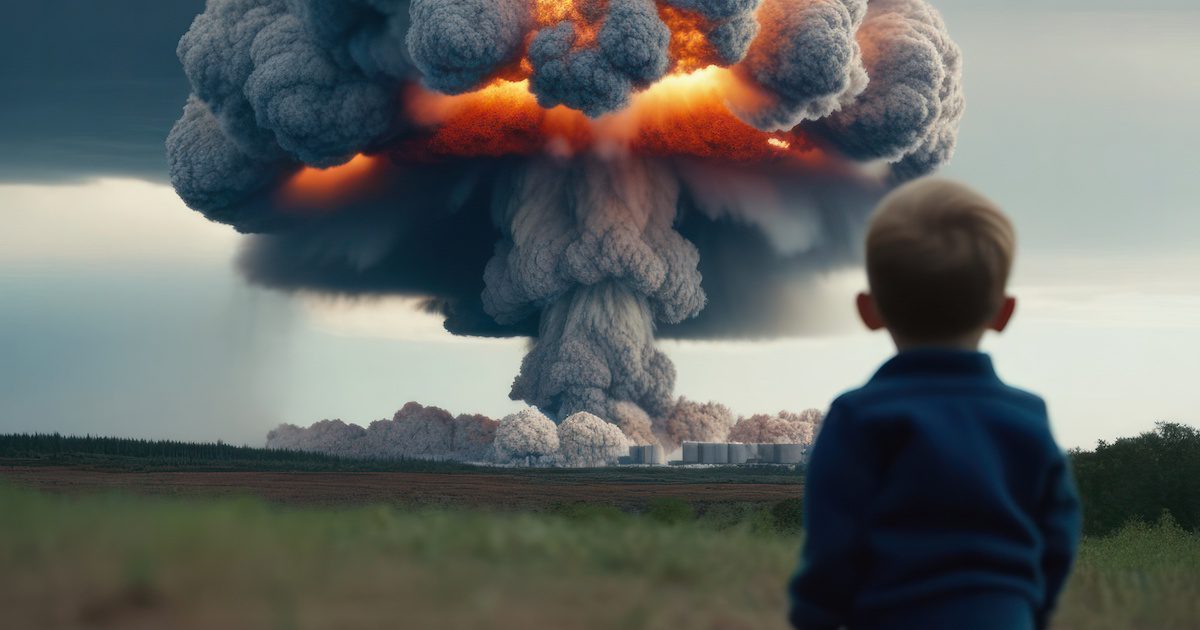
Threads premiered in 1984, embedding the grim reality of nuclear war – and its fallout – into the public psyche forever. David Barnett explores the film’s enduring legacy…
When 11-year-old Mark Stay was enduring a double maths lesson, some time in 1984, a long siren sounded from outside the school buildings.
“Everyone froze, even the teacher,” recalls Mark, now 51. “It was very similar to the four-minute warning siren. Then she remembered that some buildings nearby were being demolished and this was a detonation warning. Still, nothing like the cold chill of imminent annihilation to clear the mind.”
It’s not surprising everyone was a little jumpy. The memory of Threads was still lingering in their minds. Broadcast at 9.30pm on the BBC on Sunday September 23rd, 1984, just a couple of weeks into the new school year, Threads has imprinted itself on the psyche of a generation, like the shadows of obliterated people burned into the pavements of Hiroshima.
Ask any Brit aged over 50 about Threads, and the chances are they’ll go a little pale, shudder, and start telling you about melting milk bottles and women weeing down their legs in the street.
The birth of the docudrama
It was what today we’d call a docudrama, a combination of the fictional stories of individuals caught up in a nuclear attack on Sheffield and the narration of science broadcaster Paul Vaughan, which gave the facts about atomic war he imparted a horrifying, familiar veracity.
This is what it would be like… this is what would happen to us
There was a ‘Play for Today’ vibe about the story of Jimmy and Ruth, a young couple preparing to get married after finding out Ruth is pregnant. In the background, TV reports and newspaper headlines outlined the growing international tensions with the Soviet Union, but it all takes a back seat to the domestic tribulations… until the nukes start flying, and Sheffield (among most other cities) is bombed.
The memory of the mushroom cloud rising over the city still chills. This is what it would be like. This is not some American science fiction drama, positing the destruction of New York or Los Angeles or other far-off places we only ever saw on TV or at the cinema. This is what would happen to us.
Those behind Threads, nuclear war film
Jimmy was played by West Yorkshire born Reece Dinsdale, who went on to star in A Private Function and the sit-com Home To Roost, while Ruth was Karen Meagher, who the following year took the role of Miss Broom in the ultimate palate cleanser, the kids’ TV show Jonny Briggs.
Threads was produced and directed by Mick Jackson, who, once he got nuclear annihilation out of his system, turned to romantic movies such as LA Story and The Bodyguard in the early 1990s. The screenplay was written by Barry Hines, the South Yorkshire-born author of A Kestrel for a Knave, later filmed by Ken Loach as Kes. Who among us can say we didn’t sit in an English class while a big old TV and a video player the size of a small family car was wheeled in for us to watch that?
Hines brought his trademark northern grit to the script, but there was to be no happy ending. Not even a slightly sad, though redemptive, ending in Threads.
There was just going to be endless bleakness and horror. The mushroom cloud rising over Sheffield, the milk bottle melting in the intense heat from the blast, the woman in the street losing control of her bladder as realisation dawned that this was it, this was the end… that was only the beginning.
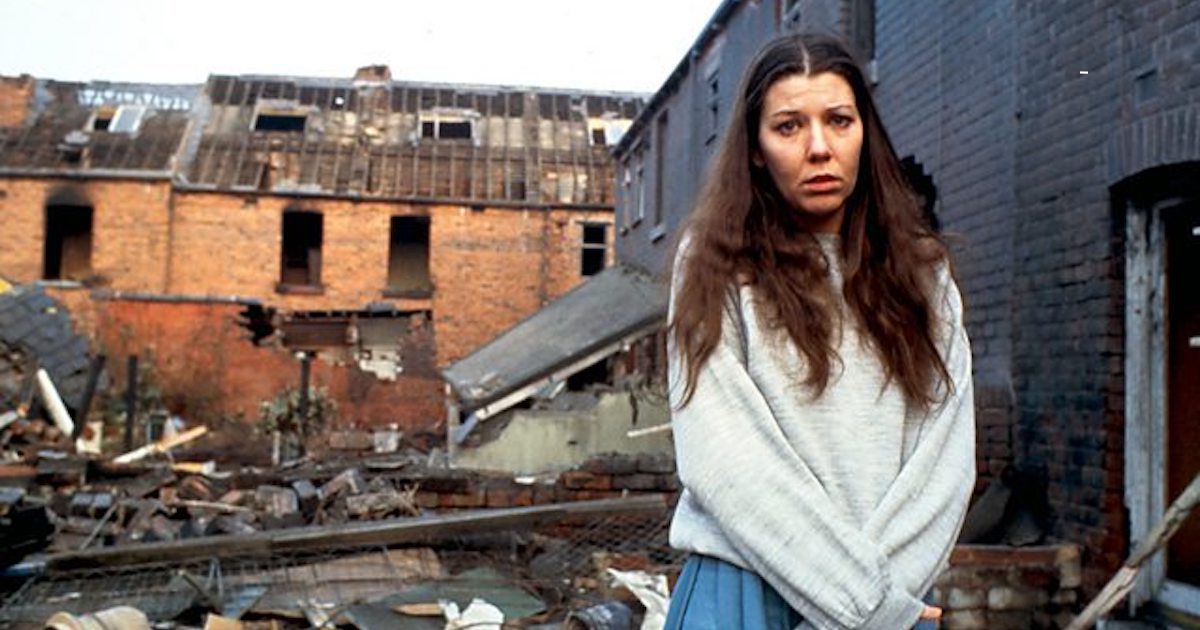
Ruth Beckett (Karen Meagher) in Threads (1984)
Gary’s experience
Gary Wilkinson, of Lincoln, was 17 when he watched Threads, and a couple of years later he would head off to Sheffield for university. He’d been aware of Threads in the run up to broadcast largely thanks to the one-off drama being given a Radio Times cover, with what has now become an iconic image.
In the wake of the nuclear attack, government protocols kick in to try to control the remnants of the cities and keep the peace
Anyone with any official links is drafted in, including an unnamed traffic warden, pictured with half his face bandaged and looking genuinely shell-shocked, and carrying a gun. The traffic warden, played by Michael Beercroft, only appeared for a moment, as an example of how martial law would have to be declared in the wake of an attack. But it’s an enduring image. The writer and broadcaster Charlie Brooker even reproduced the costume for a Halloween party a few years back.
Gary, 57, recalls, “It all added to the general feeling of doom and gloom that nuclear war was imminent. It definitely stayed with me though because I went to Sheffield University a couple of years later. I remember recognising some of the filming locations as I walked around the city for the first time – the council building, and the shopping street with the mushroom cloud. Ironically the pub they shot in was a popular student pub, but it had had a makeover so I never realised until later.”
The culture of nuclear war
Threads didn’t come out of nowhere, of course. If you grew up in the 1980s, the threat of nuclear war was a very real one. The year 1984 had arrived carrying all the baggage of George Orwell’s dystopian novel. The rise of the surveillance society and admonishments that if you’d done nothing wrong, you had nothing to fear from the CCTV cameras suddenly sprouting on streets.
The miners went on strike and felt the steel rod of an authoritarian establishment. We had an Iron Lady in Downing Street and a Hollywood Cowboy in the White House, and the special relationship between the Thatcher’s Britain and Reagan’s America seemed destined to take us on a mutually assured destruction collision course with the Soviet Union.
The year after Threads was released, America produced its own take with The Day After. WarGames, starring Brat Packer Matthew Broderick, had been released in cinemas the previous year and was a big hit on VHS in 1984, giving a Hollywood thriller gloss to impending nuclear destruction. Then Raymond Briggs’ When The Wind Blows was adapted as an animated film about the heartbreaking end of the world from the perspective of two pensioners.
The charts were the soundtrack to the apocalypse. Frankie Goes to Hollywood’s pounding Two Tribes had a video featuring wrestlers wearing the heads of Ronald Reagan and Soviet Communist Party secretary Konstantin Chernenko. Nena’s 99 Red Balloons wrapped Armageddon up in a catchy Europop beat. The video to Ultravox’s Dancing With Tears In My Eyes was about a meltdown at a nuclear power station.
An unhappy ending
And all of these were just in 1984. It’s no wonder that by the time Threads was broadcast, we were all certain of only one thing: the world was going to burn. And if somehow we survived, Threads showed us how terrible that would be.
Moving on from the initial attack, it showed a reduced population of a few million trying to claw their way out of the dark ages. Ending with Ruth dying and her young daughter trying to survive in the ruins, getting pregnant, and giving birth to a stillborn, horribly mutated child.
There was not going to be a Hollywood ending if those nukes started flying.
Planning our way out
I was 14 when I watched Threads, and was already fearful of what felt like the inevitable nuclear war. I watched with my parents, feeling a growing sensation of mounting dread. My mum, watching the breakdown of society in the aftermath, said quietly, “If that happens I’m going to get a gun and shoot us all.”
“You’re not going to shoot me!” said my dad. He planned to go up to Scotland and basically go fishing if the mushroom cloud appeared. Nobody asked where mum was going to procure a gun.
My mum, watching the breakdown of society in the aftermath, said quietly, “If that happens I’m going to get a gun and shoot us all.”
The next day, everyone was talking about it at school. My main memory of that is people commenting gleefully about the coloured vomit issued by those slowly dying of radiation sickness.
“Kids at school were just making jokes about it,” agrees Mike Whittaker, a 52-year-old postman from Bolton. “But that was how 12-year-olds responded to everything, as far as I remember.”
Mike watched it alone on his black and white portable TV in his bedroom. “I was way too young, in retrospect. But they showed it in some schools, didn’t they? We got the Radio Times delivered so I must have seen that iconic cover. I think I had a bit of an obsession with nuclear apocalypse prior to Threads, to be honest. Scared and fascinated. Two Tribes and 99 Red Balloons didn’t help in that regard.
‘They’ve done it, they’ve bloody done it’
“The build-up was scarily real to me. The panic in the shopping centre was very upsetting. As was the ‘They’ve done it, they’ve bloody done it’ moment. The end section is obviously beyond bleak. It added to an already real sense of dread. I had apocalypse nightmares for years. Still do now occasionally.”
History repeats
The BBC has only shown Threads twice since that initial broadcast, but it’s being screened again. I’m not wholly sure I can bring myself to watch it again, even 40 years later. The unrelenting bleakness and the sheer lack of hope makes it a difficult watch.
“It brought home that a nuclear attack wouldn’t just be an awful experience that would last a week, or a month, but for decades.”
“It was grim,” agrees Steve Tanner, 56, of Birmingham. “It brought home that a nuclear attack wouldn’t just be an awful experience that would last a week, or a month, but for decades.”
Perhaps if Threads was just a piece of television history about a time long gone, we might be less traumatised by it. But aside from a few years in the 1990s, the threat of nuclear annihilation never really went away, and given the current global situation, sometimes feels as likely as it ever did in 1984.
Still, at least if it does happen, we can all live-Tweet the apocalypse and get one last joke in when the four-minute warning comes. And, as Frankie had it, if you’re unsure what the air attack warning sounds like… this is the sound…
If you can cope with it, Threads is on BBC4 on 9th October, 10:15pm

David Barnett is an author and journalist, originally from Wigan and now living in West Yorkshire. His latest novel is the folk horror WITHERED HILL, from Canelo, and forthcoming, a magical Christmas rom-com, THE LITTLE CHRISTMAS LIBRARY (Orion). He is married to Claire, a journalist, and they have two children, Charlie and Alice.
Read all about it

Leave a comment