
The floods in Valencia; tales of chaos and compassion
The shocking floods in Valencia and other parts of southern Spain wrought disaster and tragedy. Ben Marshall flew straight through the storm, and into the chaos…
The flight takes place the night the storm hits. It’s typically empty at this time of the year; I have a row to myself, as does the woman opposite me. On a row in front there are three small children, and opposite them their very young mother. The moment the seatbelt sign is turned off I lay across all three seats, put my headphones on, prop my iPad on my chest and start watching Netflix. It’s a three-hour flight, so you can get through quite a bit of telly. The woman opposite does the same.
The three children order food and play video games. I drink gin and tonic and Rioja. Then 35 to 40 minutes before we are due to land, the cabin crew go bananas. Tear-arsing it up and down the aisle shouting at people to get their seat belts on. There’s no turbulence, no nothing. But we all strap in. Five minutes later it hits. Like being on the rollercoaster at Alton Towers.
The smallest of the three boys starts crying, and reaches for his mother’s hand. His elder brothers are, like me, enjoying the ride. I’ve suffered worse turbulence. All those years flying across the Atlantic makes me a veteran, if not a connoisseur. Then shit gets really weird. Lights, like strobes at a 90s rave send the whole cabin black and white for fifteen minutes; the cabin crew appear to move in slow motion. I will later realise we’ve been flying above the storm.
Then, just as suddenly as it started it stops
Twenty minutes later we land. It is a gentle landing, and I am first off the plane and out of the airport. It’s warm in Alicante. I get on the bus, turn on my phone and start getting messages asking if I’m okay. Loads of them. I wonder why people are so concerned. This is not the first time I have been on a plane by myself. It’s not the first time I’ve been away without my wife Janine.
Thirty minutes later I am home. And I turn on the telly to witness the utter bloody carnage I had flown over only an hour earlier. A Spanish reporter will later describe it as a war zone without fighting.
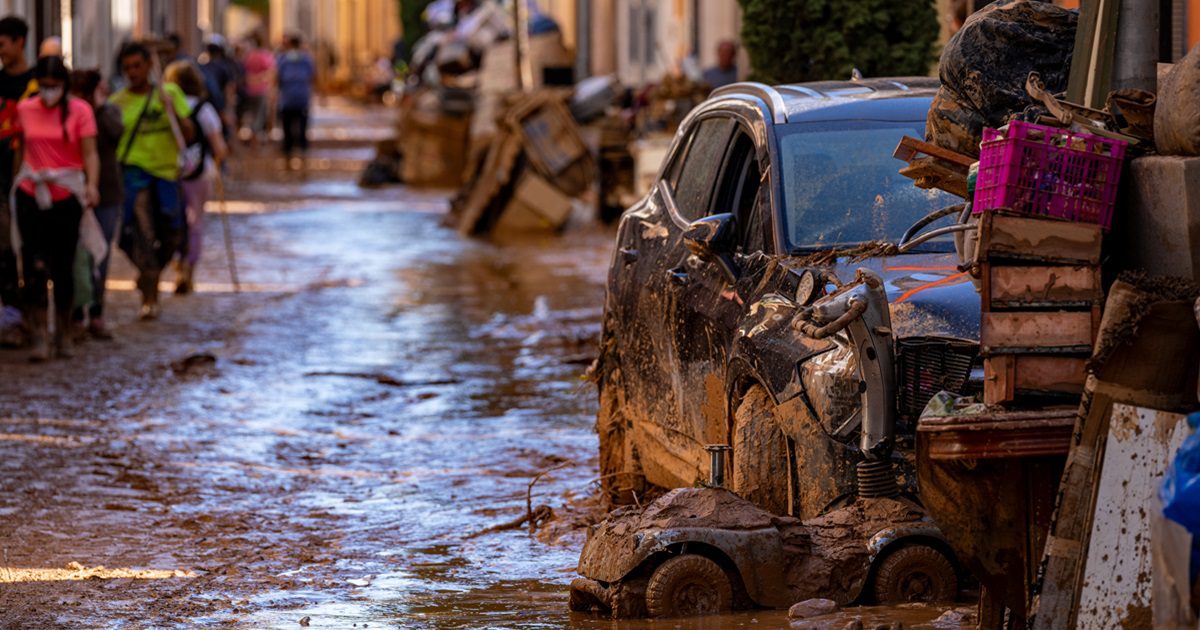
It’s the cars that get me. Swept into one another. Piled high, in unnatural, seemingly gravity defying shapes. A BMW stands vertical, on top of it a Ford, at a 45-degree angle, and another car, so coated in orange and red mud, you can’t clock the make, crowns them all.
It’s like the entirety of Valencia is some ghastly shock-art exhibition designed by JG Ballard
This spectacle is repeated over and over in every street. The mud-covered cars piled high, held aloft and at the unlikeliest of angles by twisted metal, broken house bricks and palm trees ripped from their roots. It’s like the entirety of Valencia is some ghastly shock-art exhibition designed by JG Ballard, or Warhol at his most nihilistic.
But it’s not the entirety of Valencia. Alicante and neighbouring Benidorm have been untouched. The Sierras – the mountain range that circles this area – have saved us. Embracing us like the mother of the little boy on the plane.
In the coming days I learn a great deal about Spanish floods. They are a result of DANA – Depresión Aislada en Niveles Altos – a Spanish phrase that translates to ‘depression at high levels’. Basically, a mass of warm air collides with a still and stagnant mass of cold air, at an altitude of 9,000 meters, and unleashes hell. It is an almost exclusively Spanish phenomenon, though how long that will last is probably for the climate scientists to work out.
And then the rains fall
To the north and south of me, just a few kilometres away, whole areas where there had not been a drop of rain were suddenly engulfed, as mountains turned into waterfalls and rivers overflowed. The underground carparks that serve so many Valencian apartment blocks filled with water. Or worse, mud. And once the rain stopped, roughly six hours after it had started – a whole years’ worth of rain in around a quarter of a day – the warm sun returned to harden everything. Burying people and cars alike under what is tantamount to wet cement.
The horror stories are almost unthinkable until of course you are made to think of them. After which, you can think of little else. Waist high water is the worst. People feel tempted to wade out only to have their legs chopped from beneath them by spinning manhole covers that have exploded upwards as the sewers overflow.
The horror stories are almost unthinkable until of course you are made to think of them
And that’s how people drown. You’re not going to wade out in two meters of water, but you might go out in 50, 60 centimetres of water, to try and help somebody across the road. You get your legs taken out by a manhole cover, or get dragged into a sewer moving at hundreds of kilometres per hour.
Which brings me to the smell. That is something we got a taste of here in Alicante. The toilets and sinks of my flat, bars and restaurants all bubbled up, sending the smell of human excrement wafting through our homes, streets and places of work.
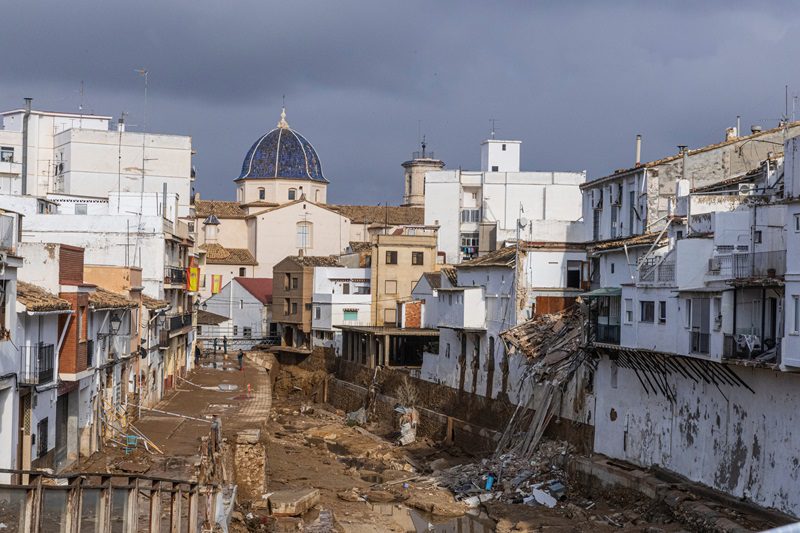
After the floods
Yet there is light
Amongst the grief and the grieving, the freshly buried, the freshly unearthed horrors, there are people with courage, decency and muscle. Not just the locals. People: Spanish, English, German, Canadian, Israeli, Algerian, Iranian, and American all coming together to help. Riding bicycles, mopeds, or on foot, they arrive with spades and shovels, brooms and wellington boots. Some turn up with full scuba diving gear to dive into the sewers and subterranean carparks.
A United Colours of Benetton of mostly young people willing to do anything to help those who need it. And freeing up the first responders, who for days have been digging and sweeping, rather than mending broken bones, if not broken hearts.
Some turn up with full scuba diving gear to dive into the sewers and subterranean carparks.
They are young. A meme is doing the rounds here, in English as all memes are. It shows a picture of some smiling 20-somethings, covered in mud, post dig, post discovery and asks: ‘Generation Snowflake?’
Amongst the grief and the grieving that’s going on, and all the fear, you have people behaving with incredible selflessness.
In the days following, emotions run high. There is the desperate urge to help. But there is also fear of it happening again, and anger that it was allowed to happen at all.
In the bars, people gather together
Spaniards like talking. Now they sit silent, glued to the news. Watching the weirdness and horror reveal itself. It’s strange to be on the periphery of death, the actual edge of disaster, but have none of it touch you.
News comes through that Málaga is about to be hit really badly. Then the wealthy area of Marbella. That’s the thing about the weather. It doesn’t respect your wealth or your cultural status or anything else. It’s going to do whatever it wants.
For those of us luckily untouched by the worst of it, there is relief and guilt. In the area of Alicante called San Blas where I live, we have just a minute of rain, but even this is enough to cover two bedrooms with a layer of water. It is hard not to think of the relentless torrent Valencia experienced, and imagine what would have happened if we’d experienced the same.
As I clean, I think about the young children who live around here, the schools. The fact that in Valencia at 8 o’clock in the evening, when the warnings were received, many families would have been out enjoying an evening meal. Here, it is normal for children to be out with their families until late in the evening. For many it would have been impossible to get to safety.
Within a few days riots begin
The people throwing bottles at police may well be those who rolled up their sleeves and went to help in the first instance. Spanish police fight back with batons and tear gas; the spectacle is alarming.
People want answers. The warning sirens and notifications went off just minutes before the storm hit – but could anyone have known? I think of my plane and its passage through the storm: if the pilot and crew hadn’t known, then how could anyone on the ground have been aware?
But I understand the anger, the need to direct it somewhere: if you dig a dead family out of an underground garage, and then later see a group of people gathering outside a government building, you are probably going to want to throw a bottle.
In time, perhaps the anger will convert to positive action – the development of flood defences and prevention of future catastrophe. And if there is hope to be found, it is perhaps that Valencia’s collective anger will become a louder voice in the fight against climate change. But here and now, that is scant consolation.
The only hope to be found amongst the devastation is in the enormous human effort that rose up in response to this catastrophe. The first responders who worked tirelessly. And those individuals who downed tools and came to help – ignoring personal danger, travelling for miles on bikes and whatever transport could be found.
It reminds me that while the weather may be powerful and merciless, humans in a crisis have a power all their own.
Donate to the Spain Relief Fund

Ben Marshall is a journalist and writer whose back catalogue sits in the Melody Maker, Loaded, GQ, Golf Punk, The Guardian, The Evening Standard, Marie Claire, Red, Rolling Stone, and Men’s Health amongst others.
Read all about it

Leave a comment